





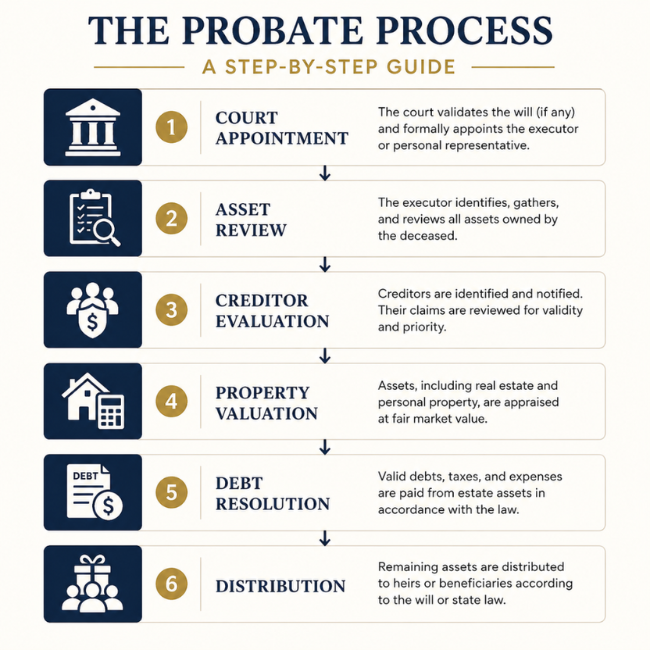
The Probate Process — A Step-by-Step Guide
How probate decisions are made refers to the structured process through which a personal representative, under court authority, makes financial and administrative choices while managing an estate. Probate decisions are governed by fiduciary duty, documentation requirements, creditor rules, and court procedure rather than personal preference.
Probate decisions are not made casually. They are governed by state law, fiduciary duty, and court procedure. However, the individual making those decisions is often doing so during a period of personal loss. That overlap between legal structure and emotional weight can shape how decisions feel.
What Guides Probate Decisions
The first principle guiding probate decisions is fiduciary duty.
A personal representative must act in the best interest of the estate. This means protecting estate assets, paying valid debts in the correct order, and distributing property according to the will or state law. Personal preference does not control the process. Statutory requirements do.
The second principle is documentation.
Decisions are typically based on financial records, account statements, property valuations, and creditor claims. Probate administration relies on verifiable information. Emotional reactions do not determine outcomes. Written records do.
The third principle is legal authority.
No decision carries legal weight until the probate court appoints a personal representative. Once appointed, that person has authority to act. Before appointment, no one has legal power to access estate assets.
For additional background, see What Is Probate and How Does It Work?
Financial Decisions During Probate
Financial decisions during probate follow a structured sequence.
First, the representative identifies assets and liabilities.
Second, creditor notice procedures are completed.
Third, claims are reviewed and prioritized.
Fourth, taxes and administrative expenses are addressed.
Finally, remaining assets are distributed.
Each step helps determine what decisions can legally and financially be made next.
The process follows a legal order rather than personal preference.
Real Estate Decisions During Probate
When real estate is involved, valuation informs decisions. The representative may obtain an appraisal or market analysis before deciding whether to retain or sell property. The decision must reflect the best interest of the estate as a whole.
When liquidity is limited, the representative may decide to sell assets to satisfy debts. That decision is driven by financial necessity rather than personal attachment.
If beneficiaries disagree, the representative must rely on statutory authority and, when necessary, court guidance. The probate court serves as the final decision-making authority if disputes arise.
For additional information, see How probate real estate is managed
Emotional Factors and Probate Decisions
Emotional factors often influence how decisions feel, even when legal standards control the outcome.
For example, selling a home may carry symbolic weight. Distributing personal property may affect family dynamics. However, the representative’s obligation is to apply legal structure to the estate’s financial reality.
Information gaps also influence decision-making.
Executors sometimes lack complete knowledge of the deceased person’s financial history. As information becomes available, probate decisions may change as additional information becomes available.
Deadlines also shape decisions.
Creditor claim periods, tax filing deadlines, and court reporting requirements limit how long certain decisions can be postponed. Delay can increase financial risk.
Professional Advisors and Probate Authority
Professional advisors may assist.
Attorneys, accountants, appraisers, and real estate professionals provide information that supports decision-making. However, final authority rests with the appointed representative, subject to court oversight.
Two common misunderstandings appear frequently.
First, some believe probate decisions are based on family consensus. While cooperation is helpful, statutory requirements control. Agreement does not override law.
Second, some assume the executor can choose outcomes freely. In reality, decisions are constrained by fiduciary duty, creditor priority, and court supervision.
For related guidance, see executor financial responsibilities
What Guides Probate Decisions
Probate decisions are guided by legal and financial requirements rather than personal preference.
Even when emotions are involved, the process still follows a structured order based on court authority, documentation, and state law.
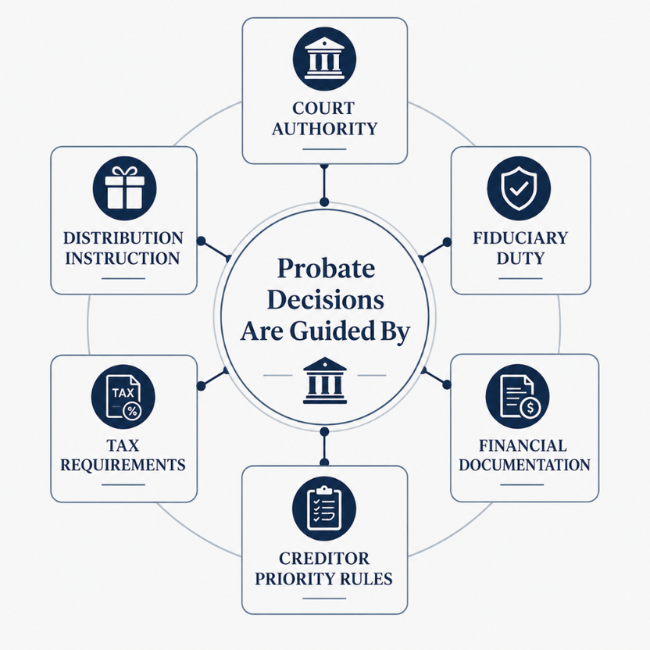
Probate Decision-Making Framework
The process is generally shaped by:
- Court authority
- State probate laws
- Financial records and documentation
- Creditor priority rules
- Tax obligations
- Instructions contained in the will or intestacy law
Each decision connects to the responsibilities of estate administration and the legal obligation to act in the best interest of the estate.
Procedural Summary
Probate decisions are made through this structured sequence:
- Obtain a court appointment
- Inventory assets and liabilities
- Notify creditors and observe statutory deadlines
- Evaluate claims based on documentation
- Apply statutory order of payment
- Consult professional valuations when necessary
- Resolve disputes through court procedures
- Distribute remaining assets according to governing law
Emotions may surround each step, but probate decisions still follow legal and financial requirements.
This explanation is provided for general informational purposes only and does not constitute legal or financial advice.