





When a loved one passes away, one of the first questions families often ask is what documents are needed for probate. Before a court can authorize someone to manage an estate, it generally requires specific documents that establish the person’s death, identify the estate, and confirm who has legal authority to act.
The exact documents required for probate vary by state, but many probate courts request similar information. Preparing these documents before filing can help reduce delays, prevent unnecessary requests from the court, and make the probate process more organized.
This guide explains what documents are needed for probate, why each document matters, and what additional paperwork may become necessary as the estate is administered.
Why Probate Documents Matter
Probate is a court-supervised legal process. Before the court can appoint an executor or personal representative, it must verify several important facts.
Among them are:
- That the individual has died
- Whether a valid will exists
- Who has authority to represent the estate
- What assets belong to the estate
- Who may inherit under the law
Without sufficient documentation, the court may postpone hearings, request additional filings, or delay the appointment of the estate representative.
Having documents prepared in advance often helps probate move more efficiently.
What Documents Are Needed for Probate?
Although every estate is different, the following documents are commonly required when opening probate.
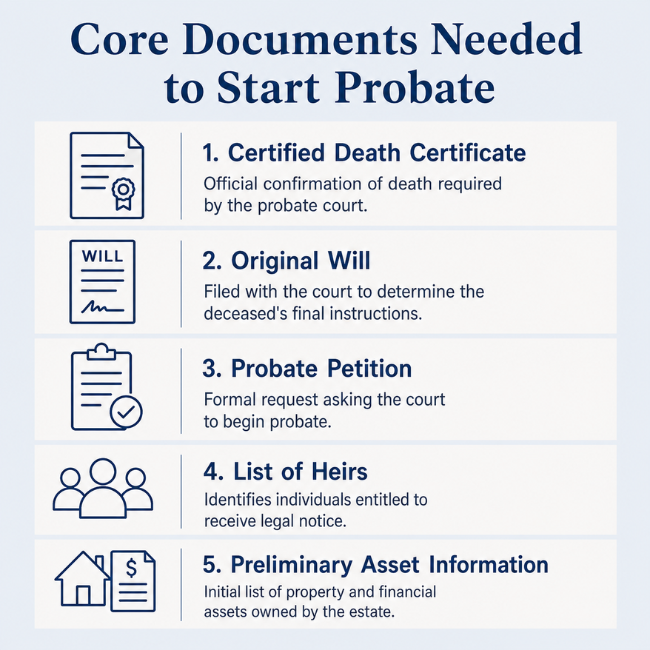
Certified Death Certificate
The certified death certificate is one of the first documents required.
This document officially confirms the death and is typically needed not only by the probate court but also by banks, insurance companies, investment firms, government agencies, and other financial institutions.
Most families obtain multiple certified copies because several organizations may require original certified documents rather than photocopies.
The Original Will
If the deceased left a will, the original signed document is generally filed with the probate court.
The court reviews the will to determine whether it appears legally valid under state law and whether it names an executor to administer the estate.
If multiple versions of a will exist, the court may need additional information before determining which document controls the estate.
If no will exists, probate usually proceeds according to the state’s intestacy laws.
Petition to Open Probate
Every probate case begins with a formal petition filed with the appropriate probate court.
This document generally includes:
- The deceased person’s legal name
- Date of death
- County of residence
- Information about the will
- Names of interested parties
- Request to appoint an executor or personal representative
The petition officially asks the court to begin the probate process.
Executor or Personal Representative Information
The individual requesting appointment as the executor or personal representative usually provides identifying information such as:
- Full legal name
- Address
- Contact information
- Relationship to the deceased
Some courts also require the proposed executor to sign forms accepting the appointment and acknowledging their legal responsibilities.
The court uses this information when deciding whether to issue legal authority to administer the estate.
List of Heirs and Beneficiaries
Many probate courts require information identifying the people who may have legal rights in the estate.
This may include:
- Surviving spouse
- Children
- Grandchildren
- Parents
- Siblings
- Individuals named in the will
Providing complete information helps ensure that all legally required notices are sent to interested parties.
Preliminary Asset Information
When determining what documents are needed for probate, families are often surprised that they do not always need a complete inventory immediately.
However, courts frequently request preliminary information showing the types of assets owned by the deceased.
Examples include:
- Real estate
- Bank accounts
- Investment accounts
- Business interests
- Personal property
- Vehicles
A more detailed inventory is often filed later after the executor has gathered additional records.
Financial Documents That May Be Helpful
Although not always required to open probate, financial records often become important soon afterward.
Examples include:
- Bank statements
- Brokerage statements
- Retirement account records
- Mortgage documents
- Property deeds
- Vehicle titles
- Tax returns
- Loan information
- Credit card statements
- Insurance policies
Collecting these documents early often makes later stages of probate easier because the executor can identify estate assets and financial obligations more efficiently.
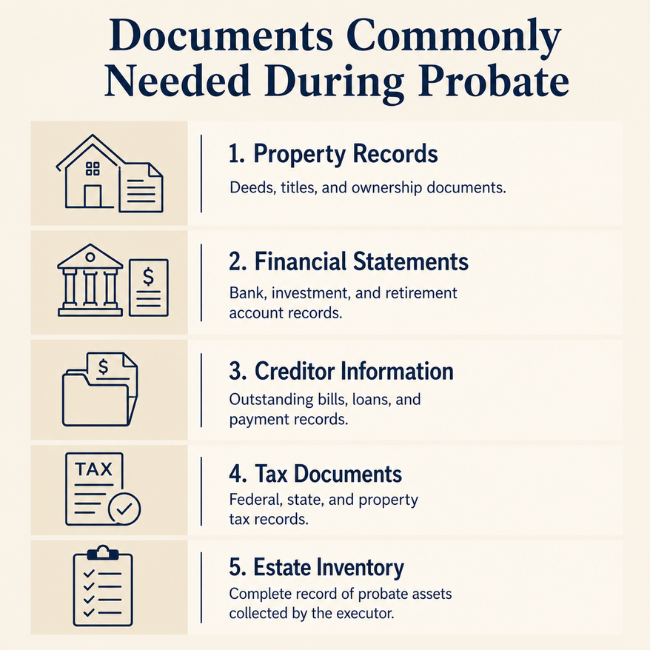
Property Ownership Documents
Real estate frequently represents one of the largest assets in an estate.
Documents that may become important include:
- Property deeds
- Mortgage records
- Property tax statements
- Homeowner’s insurance information
- Closing documents from previous purchases
These records help establish ownership and may become necessary if the property will eventually be transferred or sold.
Additional Documents That May Be Required During Probate
Opening probate is only the beginning of the process. As the estate moves forward, the executor or personal representative may need to provide additional documents requested by the probate court, financial institutions, creditors, or other organizations.
These documents often include:
- Letters Testamentary or Letters of Administration issued by the court
- A complete inventory of estate assets
- Professional appraisals for certain property
- Notices provided to heirs and beneficiaries
- Notices sent to creditors
- Receipts showing payment of estate expenses
- Estate accounting records
- Final distribution documents
Not every estate requires every document. The complexity of the estate, the types of assets involved, and state probate laws all influence what additional paperwork may become necessary.
Documents Needed to Identify Estate Assets
One of the executor’s primary responsibilities is identifying everything the deceased owned.
Helpful documents include:
- Property deeds
- Vehicle titles
- Stock certificates
- Business ownership records
- Safe deposit box information
- Retirement account statements
- Life insurance policies
- Pension information
- Digital asset records
- Personal property inventories
Gathering these records early allows the executor to determine which estate assets belong to the probate estate and which assets transfer outside of probate.
Documents Related to Estate Debts
Probate involves more than distributing assets. Estate debts must also be identified and reviewed before distributions can usually occur.
Documents commonly used include:
- Credit card statements
- Medical bills
- Mortgage statements
- Home equity loan information
- Personal loan documents
- Utility bills
- Property tax records
- Federal and state tax information
These records help determine what financial obligations belong to the estate and whether sufficient assets exist to satisfy those obligations.
For related information, see Who Pays Debts During Probate.
What Happens If Documents Are Missing?
Families are often concerned because they cannot immediately locate every document after a loved one dies.
Missing paperwork does not necessarily prevent probate from moving forward.
For example:
- A missing property deed can often be replaced through county land records.
- Lost financial statements may be obtained directly from banks or investment firms.
- Insurance companies usually maintain copies of policy information.
- Vital records offices can issue additional certified death certificates if more copies are needed.
If the original will cannot be located, the situation becomes more complicated. Probate courts may require additional evidence before determining whether another copy can be accepted or whether the estate must proceed under state intestacy laws.
Because each state has different legal standards, professional legal guidance may become necessary whenever significant probate documents cannot be found.
Tips for Organizing Probate Documents
Keeping probate documents organized can save considerable time throughout estate administration.
Many executors create separate folders for:
- Court filings
- Financial accounts
- Real estate records
- Tax documents
- Insurance information
- Creditor correspondence
- Receipts and expenses
- Estate distributions
Maintaining organized records also makes it easier to prepare required inventories, accountings, and reports if requested by the probate court.
Common Mistakes When Gathering Probate Documents
Several common mistakes can delay probate unnecessarily.
These include:
- Filing photocopies when originals are required
- Forgetting to obtain certified death certificates
- Overlooking beneficiary designation forms
- Failing to identify all financial accounts
- Misplacing important correspondence from the probate court
- Waiting too long to organize estate records
Careful preparation at the beginning of probate often reduces delays later in the process.
Frequently Asked Questions
Do I Need the Original Will for Probate?
In many states, the probate court expects the original signed will if one exists. If the original cannot be located, additional legal procedures may be required before probate can continue.
How Many Certified Death Certificates Should I Obtain?
Many families request multiple certified copies because banks, insurance companies, investment firms, and government agencies often require original certified documents.
Can Probate Begin Before Every Financial Document Is Found?
Yes. Probate frequently begins before every asset has been identified. Additional financial information is often gathered after the executor receives legal authority from the court.
Are Probate Documents the Same in Every State?
No. Every state has its own probate statutes and court procedures. While many required documents are similar, filing requirements and forms vary by jurisdiction.
Can Probate Be Delayed Because Documents Are Missing?
Yes. Missing documents may delay portions of the probate process, particularly if they involve the original will, proof of ownership, or information needed to identify heirs or estate assets.
Key Takeaway
Understanding what documents are needed for probate allows families to prepare before filing with the court. Although requirements differ from one state to another, most probate proceedings begin with documents establishing the death, identifying the estate, confirming the executor’s authority, and providing information about heirs and estate assets.
Organizing these records early can reduce delays, improve communication with financial institutions, and help the probate process move forward more efficiently.
Conclusion
Knowing what documents are needed for probate is one of the first steps in administering an estate. While every probate case is unique, most courts require documentation confirming the death, identifying the deceased’s assets, establishing who has authority to act, and providing information about beneficiaries and heirs.
Additional records are often gathered throughout probate as the executor identifies property, addresses financial obligations, and prepares the estate for final distribution. Because probate laws and filing requirements differ by state, families should always follow the procedures established by the appropriate probate court and seek qualified legal guidance when necessary.
What Documents Are Needed for Probate?
This article is provided for general informational purposes only and does not constitute legal, financial, or tax advice. Probate laws and court procedures vary by state. Individuals should consult a qualified probate attorney or other appropriate professional regarding their specific circumstances.