





Who is responsible for debts after death? Many people ask who is responsible for debts after death when probate begins. In most cases, the estate is responsible for debts after death, and the probate process determines how those debts are reviewed and paid according to law.
Debts do not automatically transfer to relatives. Instead, the probate court process establishes authority, identifies assets, and applies statutory rules to determine how obligations are handled.
Section 1 — Explanation: How Debts Are Handled in Probate
When examining who is responsible for debts after death, the starting point is the estate. The estate becomes the legal entity responsible for debts after death once the court appoints a personal representative.
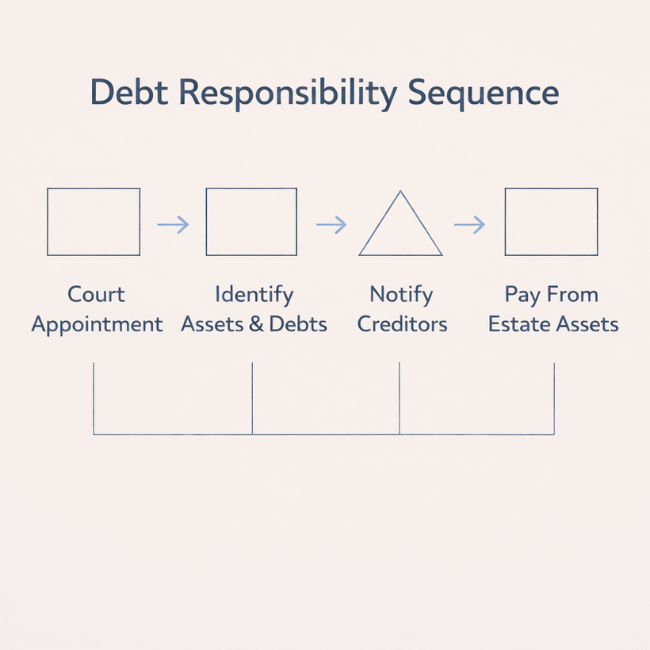
Although procedures vary by state, the structure generally follows four steps.
Step 1 — Court Appointment
First, a petition is filed with the probate court. The court appoints a personal representative. This appointment creates legal authority to act on behalf of the estate.
Without court-issued authority, no one may access accounts, negotiate with creditors, or pay debts.
Step 2 — Identifying Assets and Liabilities
Next, the personal representative identifies probate assets and outstanding debts.
Assets may include:
- Real estate
- Bank accounts
- Investment accounts
- Personal property
Debts may include:
- Credit cards
- Medical bills
- Mortgages
- Personal loans
- Taxes
The representative compiles a formal inventory of assets and a list of known obligations.
Step 3 — Notifying Creditors
Then, creditors are notified according to state law. In many jurisdictions, public notice is required, and known creditors may receive direct notice. Creditors are given a limited time to file claims.
Only valid claims are eligible for payment.
Step 4 — Paying Debts From Estate Assets
After claims are reviewed, valid debts are paid from estate assets. If the estate has sufficient funds, debts are paid in full. If funds are limited, state law determines payment priority.
For example, administrative expenses and taxes often take priority over unsecured credit card balances.
If the estate lacks sufficient assets, some debts may remain unpaid. In that case, unpaid amounts generally remain with the estate rather than transferring to heirs.
Section 2 — Who Is Responsible for Debts After Death in Probate?
When asking who is responsible for debts after death in probate, it is important to distinguish estate liability from personal liability.
In most cases, the estate is responsible for debts after death. The probate court process determines how claims are reviewed and how estate assets are applied.
Relatives are not automatically responsible. Personal responsibility arises only if a separate legal obligation exists.
Section 3 — What People Often Misunderstand
When considering who is responsible for debts after death, several misunderstandings appear.
Family members automatically inherit debt
In most situations, they do not. Responsibility remains with the estate unless someone co-signed or jointly held the account.
To understand how this applies in practice, see Do You Inherit Debt During Probate?
A spouse is always responsible
Responsibility depends on how the debt was structured and on state law. Community property states may apply different rules than common law states.
Creditors can demand payment from anyone
Creditors may contact relatives for information, but payment responsibility generally rests with the estate unless a contract provides otherwise.
Debts must be paid before probate begins
Debts are addressed within probate after authority is granted by the court.
Section 4 — When Responsibility May Be Different
Co-Signed or Joint Debt
If someone co-signed a loan or jointly held a credit account, that person may remain legally responsible under contract law.
Secured Debt
Mortgages and vehicle loans are secured by property. If payments are not maintained, the lender may enforce its security interest against the asset itself.
Community Property States
In community property states, spouses may share responsibility for certain debts incurred during marriage. State statutes define this scope.
Insolvent Estates
If estate debts exceed estate assets, the estate is considered insolvent. Debts are paid according to statutory priority. Lower-priority creditors may receive partial payment or none.
In each case, responsibility is determined by contract terms and state law.
Section 5 — Key Point
Who is responsible for debts after death? In most cases, the estate is responsible for debts after death, and the probate process determines how valid claims are reviewed and paid.
Personal responsibility applies only when a separate legal obligation exists, such as a co-signed agreement or statutory rule. The probate court establishes authority first. Debt resolution follows. Distribution occurs only after obligations are addressed.
This article is provided for general informational purposes only and does not constitute legal or financial advice.