





How to Choose the Right Probate Real Estate Agent
Choosing a probate real estate agent is not simply about selling a property. Probate sales often involve court procedures, legal requirements, documentation, and communication among multiple parties. The agent selected for the transaction may play an important role in helping the process move forward in an organized and informed manner.
A probate property sale can differ significantly from a traditional real estate transaction. Understanding what to look for in a probate real estate agent can help families, executors, and personal representatives make a more informed decision.
Why Probate Real Estate Is Different
Probate real estate transactions frequently involve additional responsibilities that are not present in a conventional home sale.
Depending on the circumstances, a probate sale may require:
- Court approval
- Additional documentation
- Coordination with attorneys
- Communication with beneficiaries
- Compliance with probate procedures
These requirements can affect timelines, marketing decisions, negotiations, and closing procedures.
Because probate sales operate within a legal framework, experience with probate-related transactions may be beneficial.
Why Probate Experience Matters
Not every real estate professional regularly works with probate properties.
A probate real estate agent may be familiar with:
- Probate timelines
- Court-related requirements
- Estate documentation
- Communication with legal professionals
- Probate sale procedures
This familiarity can help reduce confusion and improve coordination throughout the transaction.
Executors and personal representatives are often managing multiple responsibilities simultaneously. Working with an agent who understands probate-related issues may help support an organized process.
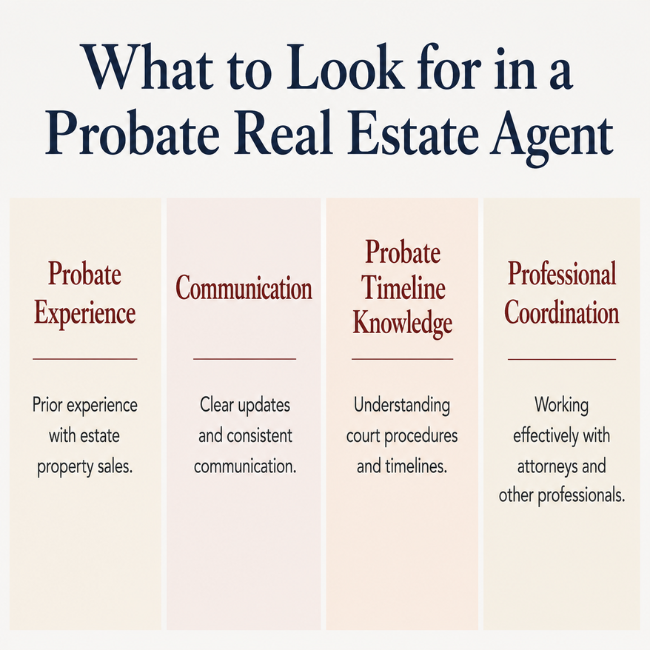
What to Look For in a Probate Real Estate Agent
When evaluating a probate real estate agent, several factors may be worth considering.
Experience is one factor, but communication and professionalism are also important.
Potential areas to evaluate include:
- Prior probate sales experience
- Knowledge of probate procedures
- Communication style
- Responsiveness
- Ability to coordinate with attorneys and other professionals
- Understanding of documentation requirements
A qualified agent should be able to explain their process clearly and answer questions directly.
Many families find it helpful to discuss how updates will be provided, how decisions will be communicated, and what level of involvement will be expected throughout the sale.
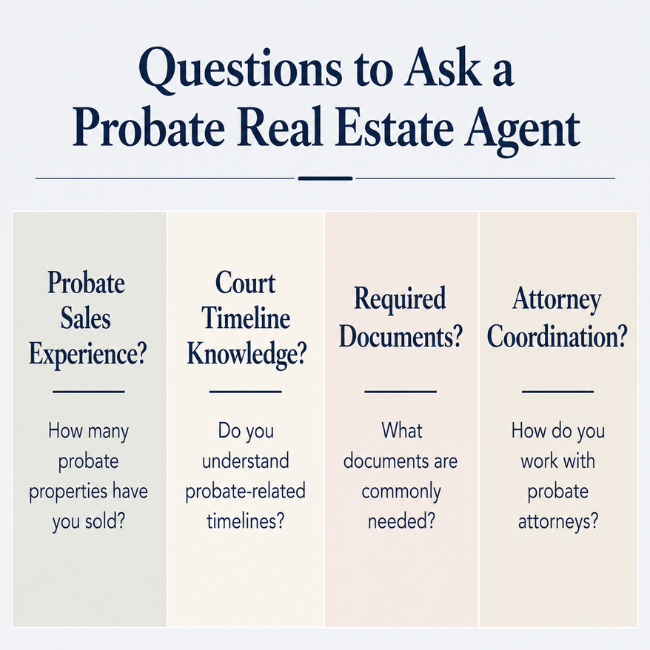
Questions to Ask Before Choosing an Agent
Interviewing more than one agent can help establish a useful comparison.
Questions may include:
- How many probate transactions have you handled?
- Are you familiar with court-related probate requirements?
- How do you communicate updates during the process?
- What documents are commonly required?
- How do you coordinate with probate attorneys?
- What challenges commonly arise during probate sales?
The purpose of these questions is not necessarily to find identical answers. Rather, the responses may provide insight into the agent's experience, communication style, and familiarity with probate-related transactions.
Understanding Referrals and Professional Recommendations
Executors and families sometimes receive referrals from attorneys, financial professionals, family members, or friends.
Professional recommendations can be helpful sources of information. However, it may still be beneficial to interview the agent and evaluate whether the individual is the right fit for the situation.
Questions regarding experience, communication practices, and probate familiarity remain important regardless of how the referral was received.
The final decision should be based on the needs of the estate and the comfort level of the individuals responsible for the sale.
Understanding the Probate Sale Process
A probate real estate transaction often includes multiple stages.
While procedures vary by state, the process may involve:
- Property evaluation
- Listing preparation
- Marketing activities
- Offer review
- Contract negotiation
- Closing procedures
- Distribution of proceeds according to probate requirements
A probate real estate agent should be able to explain how these stages fit within the broader probate process.
Clear explanations may help establish expectations regarding timing, responsibilities, and next steps.
Common Misunderstandings
Any Real Estate Agent Handles Probate the Same Way
Many agents are capable professionals, but probate sales can involve procedures that differ from traditional transactions.
Experience with probate-related matters may provide additional familiarity with the process.
Probate Real Estate Is Only About Selling a House
The sale of a property is often only one component of a larger estate administration process.
Communication, documentation, coordination, and procedural requirements may also influence the transaction.
Referrals Automatically Mean the Best Choice
A referral can be a useful starting point, but it does not replace independent evaluation.
Interviewing the agent and asking detailed questions may provide additional information that helps support decision-making.
Key Point
Choosing the right probate real estate agent involves more than selecting someone to market a property. Probate transactions often require coordination, communication, documentation, and familiarity with estate-related procedures.
Evaluating experience, communication practices, probate knowledge, and professional coordination can help families and executors make a more informed decision when selecting an agent to assist with a probate property sale.
This content is for general informational purposes only and does not constitute legal, financial, or real estate advice. Probate laws and procedures vary by state. Consult qualified professionals regarding your specific situation.
This article is shared for informational purposes.
See our full disclaimer.